Starving by 3 PM? Look at your breakfast first. Here’s how much protein you actually need.
How much protein you need, in plain numbers: the RDA, what experts suggest after 40, 25 to 30 grams per meal and a real-food sample day.

The short answer: To figure out how much protein you need, start with 0.8 grams per kilogram of body weight, which is about 55 grams for a 150-pound woman. That’s the minimum, though. Many experts suggest 1.0 to 1.2 grams per kilogram after 40, and more if you strength train, which often lands between 70 and 100 grams a day.
It’s 3 PM. You had coffee and a granola bar at 7, a salad at noon, and now you’d fight someone for the snack drawer. Sound familiar? So before you blame your willpower, look at your plate. Knowing how much protein you need, and spreading it across the day, may help you feel fuller and more steady.
Also, this isn’t about tracking every bite forever. Instead, it’s a simple number, a few easy swaps and a sample day you can actually cook.
How much protein do you actually need?
The official number is the RDA: 0.8 grams of protein per kilogram of body weight. The Harvard Nutrition Source puts it simply: that’s just over 7 grams for every 20 pounds you weigh. So a 140-pound woman needs about 50 grams a day.
But here’s the catch. The RDA is the amount that prevents a shortfall in most healthy adults. It’s a floor, not a goal. That’s why expert groups on aging recommend more for older adults, and sports nutrition groups suggest more for people who train.
- The minimum (RDA): 0.8 g per kg, or about 0.36 g per pound.
- Women over 40 to 50: about 1.0 to 1.2 g per kg, according to expert panels on healthy aging.
- Lifting or training hard: about 1.2 to 2.0 g per kg, the range sports nutrition groups use.
- Health conditions: if you have kidney disease or another condition, your doctor sets your number.
The quick math for your body
You don’t need an app for this. First, divide your weight in pounds by 2.2 to get kilograms. Then multiply by the number that fits your life.
For example, take a 150-pound woman. That’s about 68 kilograms. At 0.8, she needs about 54 grams. At 1.2, she needs about 82 grams. And if she lifts three days a week, 1.4 puts her near 95 grams.
Once you know how much protein your body needs, write the number down and split it by four. That gives you a per-meal target you can eyeball without a scale.
In other words, most busy women who move a little and want to keep their muscle land somewhere between 70 and 100 grams. Plus, that’s easier to hit than it sounds once you split it up.
Why protein matters more after 40
Muscle naturally starts to shrink with age, and it happens faster when you sit a lot and eat light. That’s why research on aging keeps pointing to protein plus strength work as a pair. Also, protein is filling, so it can help take the edge off the afternoon crash.
Meanwhile, if your appetite is smaller, every bite has to work harder. So if you’re on a weight loss medication, our guide on what to eat on a GLP-1 shows how to protect your protein when you can only eat a little.
Spread it out: aim for 25 to 30 grams per meal
Here’s the part most of us get wrong. We eat 10 grams at breakfast, 15 at lunch and 50 at dinner. However, a well-known review of muscle research found that about 25 to 30 grams of protein per meal is a sweet spot for muscle building in both younger and older adults.
So instead of one giant steak at night, think three solid meals and one snack. As a result, you hit your number without forcing anything.
- Breakfast: 25 to 30 g
- Lunch: 25 to 35 g
- Snack: 10 to 15 g
- Dinner: 25 to 35 g
What 25 grams of protein looks like
These are rough numbers for cooked portions, so they’ll vary a little by brand and size. Still, they make the math easy.
- 3 ounces cooked chicken breast: about 26 g
- 3 ounces cooked salmon: about 22 g
- 1 can (5 ounces) tuna, drained: about 25 to 30 g
- 3/4 cup plain Greek yogurt: about 17 g
- 1/2 cup cottage cheese: about 12 to 14 g
- 2 large eggs: about 12 g
- 1 cup cooked lentils: about 18 g
- 1/2 cup firm tofu: about 10 g or more, depending on the brand
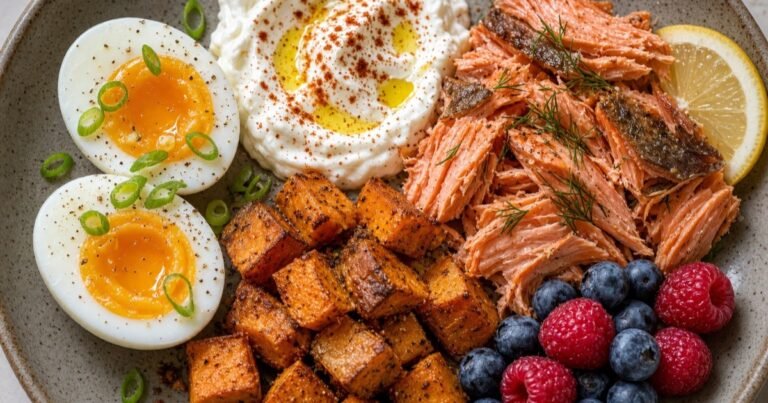
Notice something? Two eggs alone won’t get you there. So pair them: eggs plus cottage cheese toast, or yogurt plus a handful of pepitas. That’s how the numbers add up.
A sample day that hits about 100 grams
Every dish below is a real Clean Fit Fab recipe with big flavor and no seed oils. Also, none of them take long.
- Spinach scrambled eggs with scotch bonnet and thyme: breakfast, about 20 g protein, 8 minutes
- Lemon garlic tuna white bean salad: lunch, about 36 g protein, 5 minutes
- Garlic ginger marinated jammy eggs (two eggs): snack, about 12 g protein, made ahead
- Cajun baked catfish with a cornmeal crust: dinner, about 30 g protein, under 30 minutes
That’s about 98 grams for the day. Plus, if you want it lighter, swap the catfish for our garlic ginger shrimp rice bowl at about 32 grams.
Do you need protein powder?
Not really. Powder is handy on a rushed morning, and a scoop in oats or a smoothie can add 20 grams fast. However, real food brings fiber, minerals and flavor that a shake can’t. So treat powder as a backup, not the plan.
If you do buy one, look for a short ingredient list with no added sugar. Then check how much protein each scoop really gives you, since serving sizes vary a lot between brands.
Easy ways to hit your number without overthinking it
- Lead with protein. Build the plate around it first, then add vegetables and carbs.
- Prep two proteins on Sunday. For example, a pan of roasted chicken thighs and a pot of seasoned beans.
- Upgrade your snacks. Swap the granola bar for jammy eggs, Greek yogurt or roasted chickpeas.
- Use beans like a side and a protein. Half a cup adds about 7 grams plus fiber.
- Season it well. Garlic, cumin, smoked paprika and lime make protein something you want to eat, not a chore.
Finally, be patient. Moving from 50 grams to 90 grams overnight can feel like a lot. So add one higher-protein meal this week, then another next week.
Frequently asked questions
How much protein do I need in a day as a woman?
A common starting point is 0.8 grams per kilogram of body weight, which is about 50 grams for a 140-pound woman. However, many experts suggest 1.0 to 1.2 grams per kilogram after midlife, and more if you lift or train hard.
Is 100 grams of protein a day too much?
For many active women, 100 grams fits inside the normal range. Still, needs depend on your size, age and health. If you have kidney disease, talk with your doctor before you raise your protein.
Can you get enough protein without protein powder?
Yes. Eggs, Greek yogurt, cottage cheese, fish, chicken, beans and lentils can easily cover your day. Powder is a convenience, not a requirement.
What is the easiest way to add protein to breakfast?
Start with eggs, Greek yogurt or cottage cheese. Then add a second source, like beans, smoked salmon or a sprinkle of hemp hearts, to get closer to 25 grams.
Save this for your next grocery run, and send it to the friend who’s always starving by 3 PM.
This article is for general information and is not medical or nutrition advice.