






Some “healthy” smoothies have more sugar than two cans of soda. Build yours like this instead.
Are smoothies healthy? They can be. Here's why some shop smoothies carry more sugar than soda, and the simple formula for a blend that actually fills you up.
The short answer
Are smoothies healthy? They can be. A smoothie built from whole fruit, greens, protein and a little fat can be a solid breakfast. A shop smoothie made with juice, sherbet or sweetened bases is closer to dessert in a cup.
On this page
It’s 7:40 AM. You’re late, your keys are missing, and the drive-through sign says “fresh fruit smoothie.” It sounds like the healthy choice. So you grab a large one and feel good about it. Then by 10 AM you’re starving, cranky and staring at the office donuts. Sound familiar? Before you give up on blending, let’s look at why that happens and whether smoothies are healthy at all.
Here’s the good news: the blender isn’t the problem. Instead, the problem is what goes into it. Once you know the formula, a smoothie can hold you until lunch.
Are smoothies healthy, or just dessert in a cup?
Honestly, it depends on the cup. A smoothie is just blended food. So it’s only as good as what you put in it.
For example, a homemade blend of berries, spinach, Greek yogurt and chia seeds is real food. You get fiber, protein and color in one glass. On the other hand, many chain smoothies start with fruit juice and add sweetened bases. That’s where the sugar climbs fast.
A 2018 review by the Center for Science in the Public Interest found that a medium Greens ‘n Ginger at Jamba had about 440 calories and 90 grams of sugar. For context, a 12-ounce can of cola has about 39 grams. In other words, that “green” drink had more sugar than two cans of soda. Recipes change over time, so check the chain’s current nutrition guide. Still, the pattern holds: juice bases add up quickly.
Why the sugar in a smoothie hits differently
Whole fruit is sweet, too. So why does a smoothie feel different? It comes down to speed and volume.
- You drink it fast. Chewing slows you down. Sipping three cups of fruit through a straw takes about three minutes.
- It’s easy to overdo. You’d rarely eat two bananas, a mango and a cup of pineapple in one sitting. Yet a large smoothie can hold all of that.
- Juice concentrates the sugar. A medium orange has about 12 grams of sugar. Meanwhile, a cup of orange juice has about 21 grams, with almost none of the fiber.
- Blending is better than juicing. A blender keeps the skin and pulp, so the fiber stays in your glass. That’s a real point in the smoothie’s favor.
That’s also why the UK’s NHS counts juice and smoothies as just one of your five a day, however much you drink. It suggests capping them at about 150 ml a day combined, which is roughly two-thirds of a cup. Likewise, the Harvard Nutrition Source puts fruit juice on its “limit” list and suggests about one small glass a day.
What makes a smoothie actually fill you up
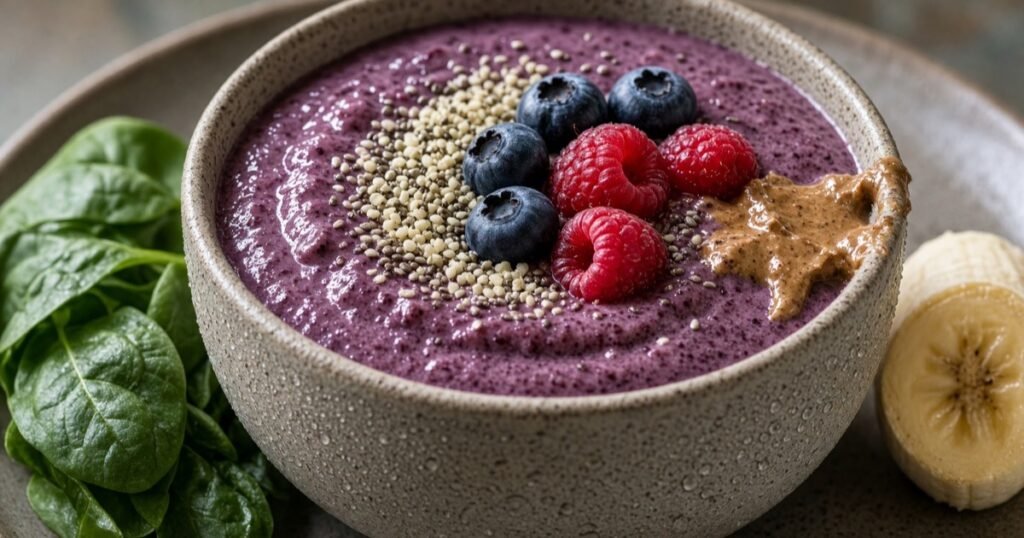
A smoothie that holds you has the same parts as a good meal. Think of it as a plate you drink. So every blend needs these four things:
- Protein, about 20 grams. Three-quarters of a cup of plain Greek yogurt gives you roughly 15 to 17 grams. Add a scoop of cottage cheese or 2 tablespoons of hemp hearts to get there.
- Fiber. A handful of spinach or kale, plus 1 tablespoon of chia or ground flax. Also, frozen cauliflower rice makes it thick and creamy without tasting like cauliflower.
- Healthy fat. A spoon of almond or peanut butter, a quarter of an avocado, or a splash of full-fat coconut milk. Fat slows things down, so the energy lasts longer.
- Fruit, about one cup. Frozen berries, half a banana, or a few chunks of mango. That’s plenty of sweetness on its own.
Then pour in a liquid: unsweetened milk, kefir, coconut water or plain water. Kefir also adds protein and live cultures, which is a nice bonus.
Flavor boosters that add zero sugar
Most “healthy” smoothies taste flat, so people add honey to fix them. Instead, borrow from kitchens that know flavor. A pinch of spice does more than a squeeze of sweetener.
- Warm spice: cinnamon, nutmeg, cardamom or a little allspice. It’s perfect for fall, especially with pumpkin puree.
- Fresh ginger: a thumb-size piece gives a bright, spicy kick, like a Caribbean ginger drink.
- Turmeric plus black pepper: golden color and an earthy warmth.
- Cacao powder: rich chocolate flavor with no added sugar.
- Citrus zest and mint: lime zest with mango, or mint with pineapple, tastes like a vacation.
- A pinch of sea salt: it sounds odd, but salt makes fruit taste sweeter.
How to order a better smoothie when you’re out
Sometimes the drive-through is what’s available. That’s real life. So here’s how to make the shop version work for you.
- Go small. Sizes at some chains reach 32 to 40 ounces. A small is usually plenty.
- Ask for no juice. Request milk or unsweetened almond milk as the base instead.
- Skip the sweet extras. Leave out sherbet, frozen yogurt, honey and turbinado sugar.
- Add protein. Plain Greek yogurt or a peanut butter add-on helps it hold you.
- Check the nutrition guide first. Most chains post sugar grams online, so look before you order.
When a smoothie is the right call
Smoothies are not the enemy. In fact, they shine on certain days. For instance, they help when you’re not hungry in the morning but know you need fuel. They’re also great after a workout, or when you’re sick of eating the same eggs again.
Plus, they’re one of the easiest ways to sneak in greens. A big handful of spinach disappears behind berries. And if you want more ideas for steady mornings, our guide to high-protein breakfasts in 5 minutes has seven that pair well with a small smoothie on the side.
The bottom line on whether smoothies are healthy: build yours like a meal, not a milkshake. Then they can absolutely earn a spot in your week.
Frequently asked questions
Are smoothies healthy for breakfast?
They can be, if the smoothie has protein, fiber and some fat. Aim for about 20g of protein from Greek yogurt, kefir or cottage cheese, add greens and seeds, and keep the fruit to about one cup.
Is a smoothie as good as eating whole fruit?
Close, but not quite. Blending keeps the fiber, unlike juicing. Still, many people feel fuller after chewing whole fruit, and the sugar in a blended drink hits faster. Having both in your week is a good balance.
How much sugar is too much in a smoothie?
There is no single number. A useful check: if most of the sugar comes from juice, sherbet, honey or sweetened bases, it’s closer to dessert. One cup of whole fruit gives you plenty of sweetness.
Why am I hungry an hour after my smoothie?
Usually it’s light on protein, fat and fiber. So add Greek yogurt or cottage cheese, a spoon of nut butter or hemp hearts, and a handful of greens. Also, sip it slowly instead of finishing it in the car.
Save this for your next rushed morning, and send it to the friend who orders the large every time.
This article is for general information and is not medical or nutrition advice.
Free dinner list
The drained-day dinner list
Thirty dinners for your worst days, plus one new recipe every week. Free, and you can unsubscribe anytime.
Comment TIRED on any of our Instagram posts and we'll send it to you.