




You Won’t Get Bulky, You’ll Get Unbreakable: The Strength Training Guide Every Woman Needs
You love Pilates but keep hearing you need to lift. Here are the 6 moves that matter, how heavy to go, and a gentle 3-day plan you can do at home.
The short answer
Strength training for women is simple to start: two or three short, full-body sessions a week built on six basic moves, with weights that feel hard by the last two reps. You won’t get bulky. Instead, you may get stronger bones, steadier energy and a body that carries you well for decades.
On this page
- Why strength training for women matters mor...
- What the research actually says
- Will lifting weights make you bulky?
- The 6 moves that matter
- How heavy should you lift?
- How should a woman start lifting weights? A...
- What to eat to build muscle
- Pilates and lifting: you don’t have t...
- Common beginner mistakes (and the kind fix...
- Keep reading
- Frequently asked questions
- The bottom line
This post has affiliate links. If you buy through them, Clean Fit Fab may earn a small commission at no extra cost to you.
You love your Pilates class. You know your way around a reformer and a pair of grip socks. Still, every podcast, every reel and maybe even your doctor keeps saying the same thing: you need to lift. Then you walk past the weight room, see the racks and the grunting, and think, that’s someone else’s territory.
It isn’t. It’s yours too. This guide to strength training for women gives you a gentle way in: the six moves that matter, how heavy to go, a 3-day plan you can do in your living room, and the real reasons muscle may be the best thing you ever build for your future self.
Why strength training for women matters more than you were told
For years, women were handed tiny pink weights and told to tone. Meanwhile, the real benefits of lifting were sitting on the other side of the gym. Here’s what muscle quietly does for you.
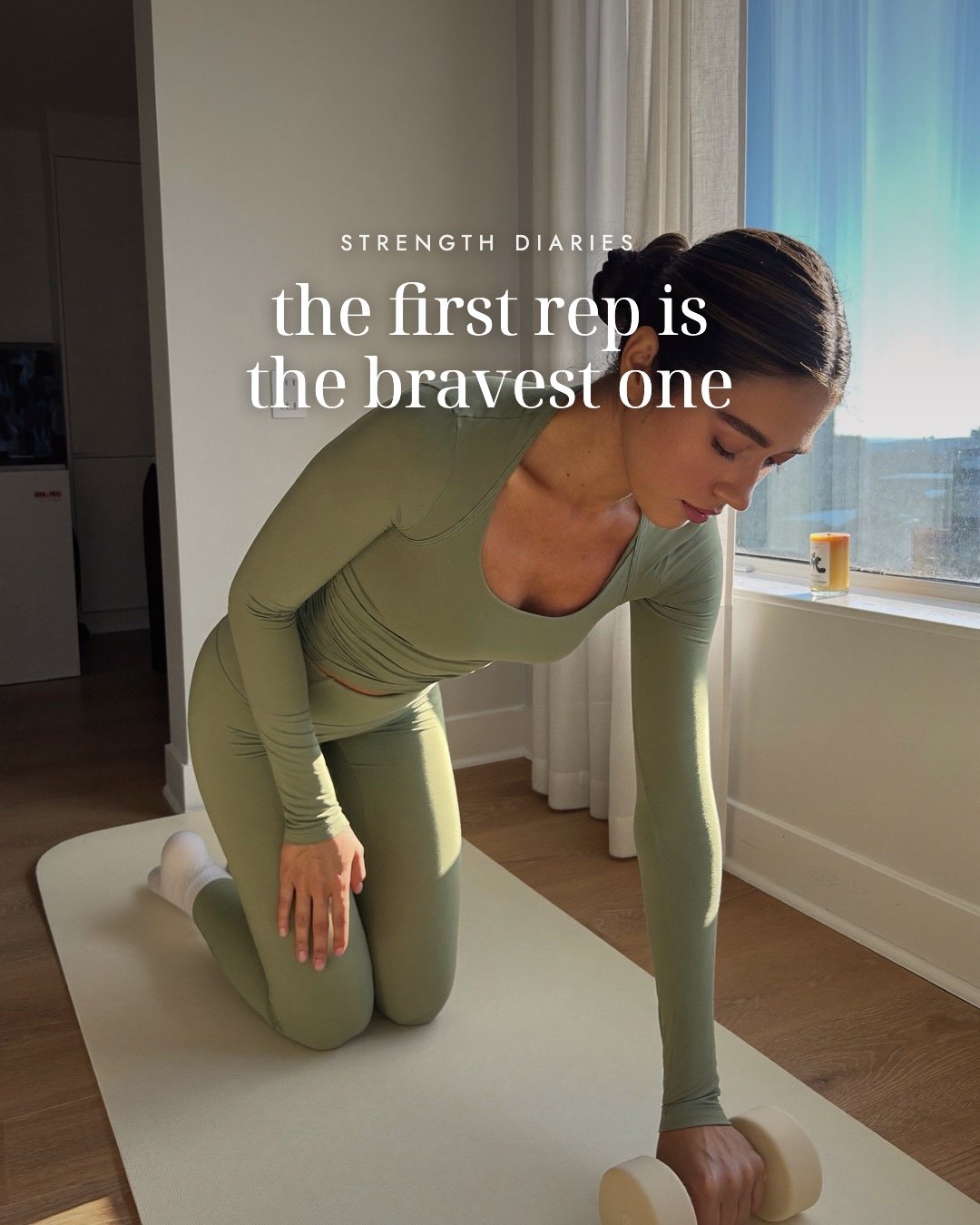
- It protects what time takes. Adults lose roughly 3 to 8 percent of their muscle each decade after 30, according to a review in the National Library of Medicine. Lifting is the best-studied way to slow that slide.
- It loads your bones. Bones respond to stress by staying dense. That matters a lot for women, since bone loss speeds up around menopause.
- It makes daily life lighter. Carrying a toddler, a car seat and three grocery bags is strength training. So practice makes those moments easier.
- It steadies your mood and your energy. Many women find that a lifting session leaves them calmer, prouder and more awake than an extra coffee.
Yet only about 1 in 4 American women meets the national guideline for muscle-strengthening activity, based on CDC survey data from 2020. So if you haven’t started, you’re in very good company. You’re also right on time.
What the research actually says
Here’s the honest picture, minus the hype. In 2024, a study supported by the National Institutes of Health followed more than 400,000 U.S. adults for about two decades. Women who did regular strength exercise had a 19 percent lower risk of dying from any cause, and a 30 percent lower risk of dying from heart disease, than women who did none. You can read the NIH summary of the study yourself.
However, that study was observational. It shows a strong link, not proof that lifting alone caused the benefit. Still, the pattern matches decades of other research, and that’s why health agencies agree on the basics.
The CDC physical activity guidelines ask adults to work all major muscle groups at least two days a week, on top of regular cardio like brisk walking. That’s the proven part. Two days. Not six.
What’s hype? The idea that you need a perfect program, a special supplement or a punishing hour in the gym. In fact, beginners make progress on almost any sensible plan they repeat. Consistency beats cleverness every time.
Who should check in first? If you’re pregnant, newly postpartum, managing a heart condition, high blood pressure, osteoporosis, a hernia or an injury, talk to your doctor or a physical therapist before you start. They can help you adjust the moves for your body.
Will lifting weights make you bulky?
This is the fear that keeps so many women in the cardio corner, so let’s be gentle and clear. No, a few sessions a week with dumbbells will not turn you into a bodybuilder.
Big muscles take years of very heavy training, a large surplus of food and, usually, far more testosterone than most women’s bodies make. The physiques you’re picturing are a full-time job. They don’t happen by accident on a Tuesday.
What usually happens instead? Your shoulders get a little shape. Your jeans fit differently. You carry the laundry basket upstairs and notice it feels light. And the tide is turning: Strava’s 2025 Year in Sport report found women were 21 percent more likely than men to log weight training. You’re not joining a boys’ club. You’re joining the women.
The 6 moves that matter
You don’t need 40 exercises. Nearly every good program is built on six basic human movements. Learn these, and you can walk into any gym, or your own living room, and know exactly what to do.
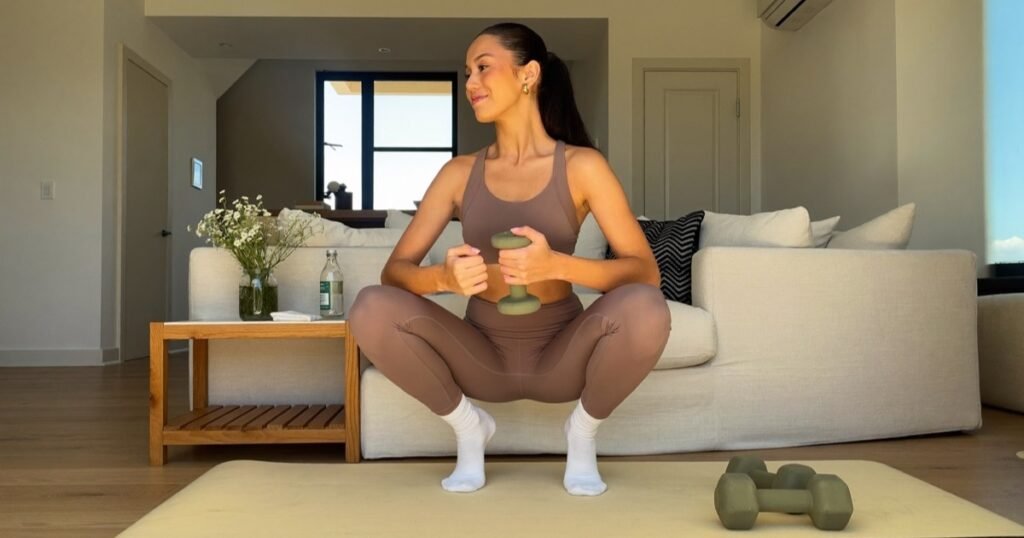
1. Squat
Hold one dumbbell at your chest, feet a little wider than your hips. Sit down and back like you’re lowering into a chair, then stand tall. Keep your chest proud and your heels heavy. Easier: squat to a real chair. Harder: slow the way down to a count of three.
2. Hinge
This is the deadlift pattern, and it trains your glutes and hamstrings. Hold two dumbbells in front of your thighs. Then push your hips straight back, let the weights slide down your legs with a flat back, and squeeze your glutes to stand. Think of closing a car door with your hips.
3. Push
Push-ups or an overhead press both count. For example, start with your hands on a couch or counter for incline push-ups. Lower your chest between your hands, then press away. Once you can do 10, move your hands lower.
4. Pull
Pulling balances all the pushing and hunching of daily life. For a bent-over row, hinge forward with a flat back and pull the dumbbells to your ribs, elbows close. Squeeze your shoulder blades together at the top, like you’re pinching a pencil.
5. Lunge
Single-leg work builds balance and strong hips. Step one foot back, lower until both knees bend, then press through your front heel to stand. Hold a wall or chair if you wobble. Wobbling is normal, and it fades fast.
6. Carry
Pick up two heavy things and walk. That’s it. A loaded carry trains your grip, your core and your posture all at once. So walk 20 to 30 steps with a dumbbell in each hand, shoulders down, ribs stacked over hips.
How heavy should you lift?
Heavier than you think, and lighter than you fear. Here’s the simple rule: choose a weight you can lift 8 to 12 times with good form, where the last two reps feel truly hard. If you could do five more, it’s too light. If your form falls apart by rep six, it’s too heavy.
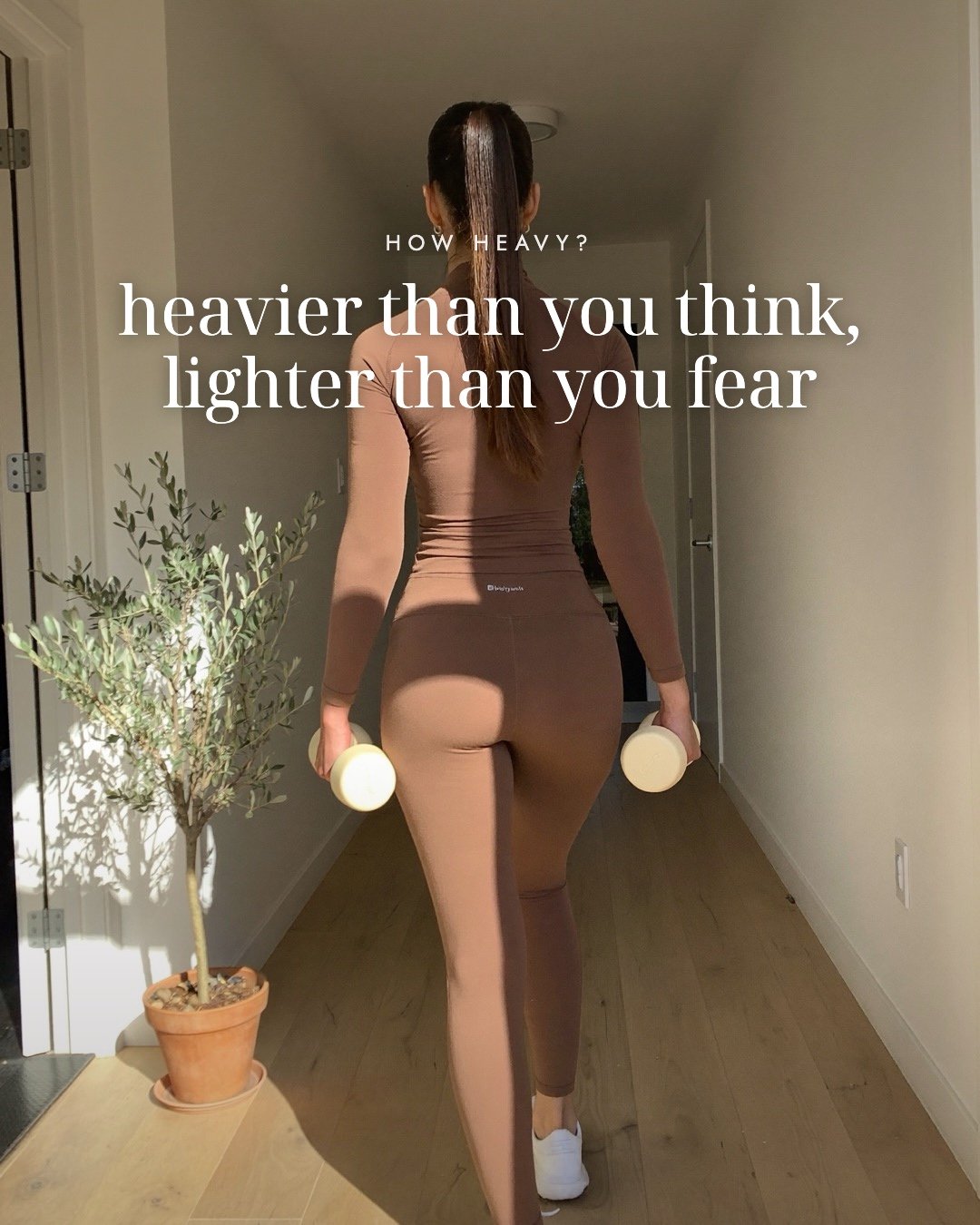
Trainers call this leaving two reps in the tank. It keeps you safe while still giving your muscles a reason to change.
- Upper body: many beginners start with 5 to 15 pounds per hand.
- Lower body: legs are stronger, so 10 to 25 pounds is a common starting place.
- When to go up: once you hit 12 clean reps on every set, add 2 to 5 pounds next time.
That small, steady increase has a name: progressive overload. It’s the whole secret. That’s why a set of adjustable dumbbells can be handy at home, since one pair grows with you instead of a rack of ten.
How should a woman start lifting weights? A gentle 3-day plan
Here is a beginner plan you can start this week. Each session takes about 25 to 30 minutes. Do them on non-back-to-back days, like Monday, Wednesday and Friday, and walk or stretch in between.
First, warm up for 3 minutes: march in place, circle your arms, and do 10 slow bodyweight squats. Then do 2 sets of each move for the first two weeks, and 3 sets after that. Rest 60 to 90 seconds between sets.
Day 1: Full body A
- Goblet squat: 10 reps
- Bent-over row: 10 reps
- Incline push-up: 8 to 10 reps
- Farmer carry: 30 steps
Day 2: Full body B
- Dumbbell deadlift (hinge): 10 reps
- Overhead press: 8 to 10 reps
- Reverse lunge: 8 reps per side
- Glute bridge: 12 reps, pause at the top
Day 3: Full body C
- Goblet squat, slow on the way down: 8 reps
- Single-arm row: 10 reps per side
- Dumbbell deadlift: 10 reps
- Suitcase carry, one weight in one hand: 20 steps per side
Finally, write down what you lifted. A plain notebook works. Next week, try to beat it by one rep or a few pounds. If you’d like a shorter option for busy days, our fall workout plan and this 20-minute indoor workout with no equipment both fit in the gaps.
Here’s the soul part. Each time you pick up something heavy on purpose, you teach yourself a quiet lesson: you can do hard things. That feeling follows you out of the room.
What to eat to build muscle
Lifting is the signal. Food is the building material. So you don’t need a complicated diet, but you do need enough protein and enough total food. Many sports dietitians suggest aiming for roughly 20 to 30 grams of protein at each meal.
After a session, a simple mix of protein and carbs works well. For example, our high-protein cottage cheese berry bowl has about 34 grams of protein, warm cardamom berries and takes 7 minutes. It tastes like dessert, and it feeds your muscles.
Not sure about your number? Our guide on how much protein you actually need walks you through it. As for creatine, it’s one of the most studied sports supplements, and some women like it. It’s optional, though. If you try it, look for third-party testing (NSF or USP) and ask your doctor first, especially if you’re pregnant, nursing, on medication or have kidney concerns.
Pilates and lifting: you don’t have to choose
If Pilates is your happy place, keep it. It builds deep core strength, control and the kind of body awareness that makes you a better lifter from day one. You already know how to brace, breathe and move with intention.
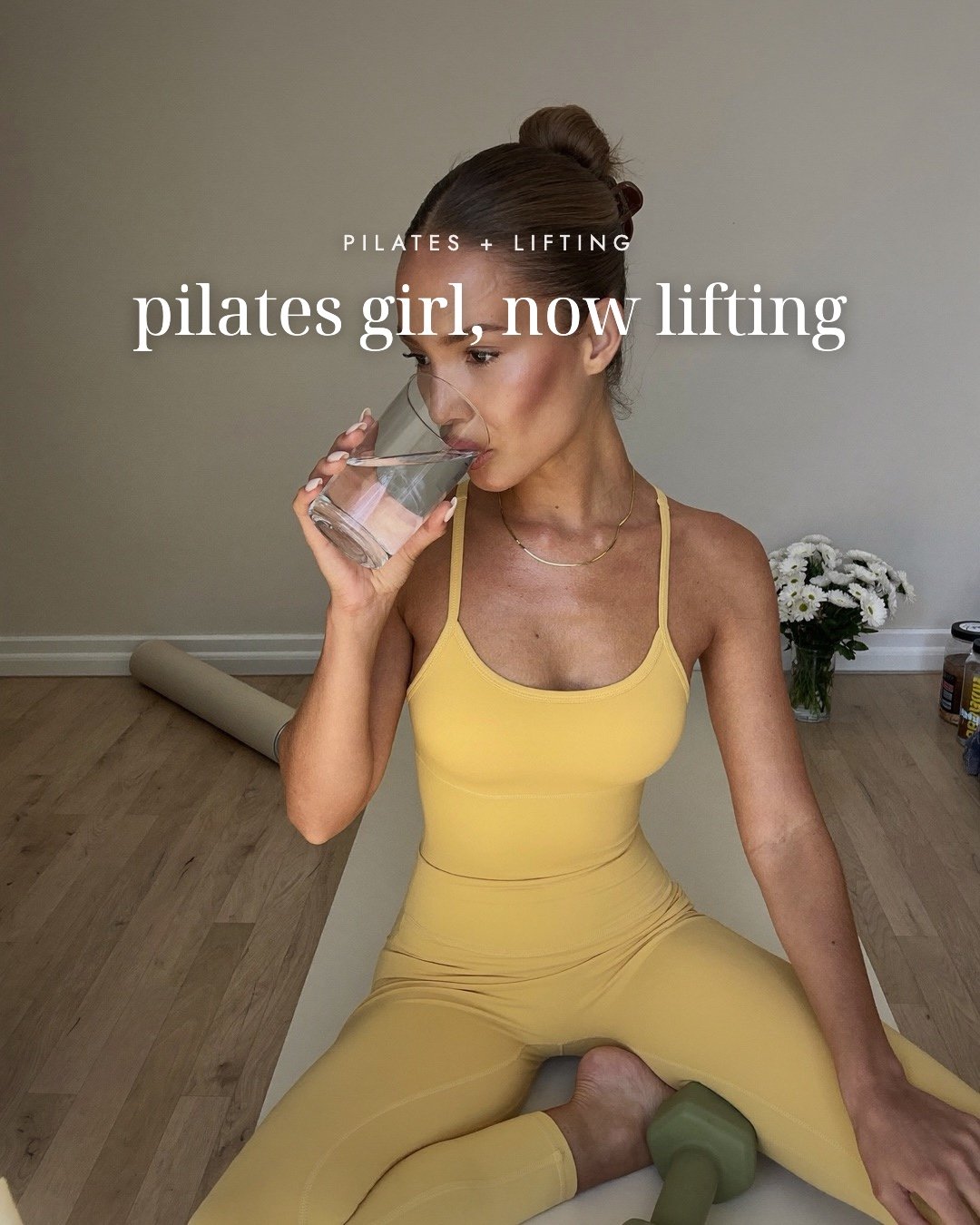
Lifting simply adds the piece Pilates doesn’t always reach: heavier load that keeps climbing over time. So think of them as partners. A lovely week might be two strength days, two Pilates classes and a few long walks. In other words, you’re not switching teams. You’re rounding out the picture.
Common beginner mistakes (and the kind fix for each)
- Going too light forever. If the weight never feels hard, your body has no reason to change. So nudge it up.
- Rushing the reps. Slow down, especially on the way down. Control builds strength.
- Skipping rest days. Muscles grow while you recover, not while you lift. Sleep counts as training too.
- Holding your breath. Breathe out on the hard part, and in on the easy part.
- Expecting overnight change. Most women feel stronger within 3 to 4 weeks. Visible change takes longer, and that’s normal.
Some muscle soreness a day or two later is expected at first. However, sharp pain, joint pain or pain that lingers is a sign to stop and get it checked. The Mayo Clinic’s strength training guide has more on safe form.
Keep reading
Every guide in our movement and longevity series, from Pilates at home to walking and strength, in one place:
Frequently asked questions
How many days a week should a woman strength train?
Two days a week is the baseline in the U.S. physical activity guidelines, and three is a lovely goal for beginners. Leave at least one rest day between full-body sessions so your muscles can recover.
Will lifting weights make me bulky?
It’s very unlikely. Building large muscles takes years of heavy training, a lot of food and, often, much higher testosterone than most women have. Most women simply look more toned and feel stronger.
How heavy should a beginner woman lift?
Pick a weight you can lift 8 to 12 times with good form, where the last 2 reps feel hard. For many beginners that’s 5 to 15 pounds for arms and 10 to 25 pounds for legs, but your own body is the guide.
Can I do strength training at home without a gym?
Yes. A pair of dumbbells, a resistance band and a little floor space are enough to train every major muscle group. Bodyweight moves like squats and incline push-ups count too.
Is Pilates enough, or do I need to lift too?
Pilates is wonderful for core strength, control and mobility. Adding two days of heavier, progressive lifting gives your muscles and bones an extra challenge, so the two work beautifully together.
The bottom line
Strength training for women was never about getting bigger. It’s about getting sturdier, steadier and more at home in your own body. So start with two days, six moves and a weight that makes you work, and let the woman you’ll be at 80 say thank you.
Save this for your first lifting day. Comment or message STRENGTH and we’ll send you the printable 3-day beginner strength plan.
This article is for general information and is not medical or nutrition advice.
Free dinner list
The drained-day dinner list
Thirty dinners for your worst days, plus one new recipe every week. Free, and you can unsubscribe anytime.
Comment TIRED on any of our Instagram posts and we'll send it to you.