10-year-olds are buying $70 retinol serums and causing skin damage. Here’s what’s really happening at Sephora — and why your pediatrician is worried.
When former Sephora employee Olivia Vaphiades encountered a 10-year-old customer insisting on purchasing Drunk Elephant retinol serum despite repeated warnings, she knew something had shifted in beauty retail. The child, accompanied by her mother, was adamant, even after being told the product was designed for mature skin, with concerns she simply didn’t have yet.
“You probably don’t need that for your young skin,” Olivia recalled telling her in a now-viral TikTok video. The purchase went through anyway.
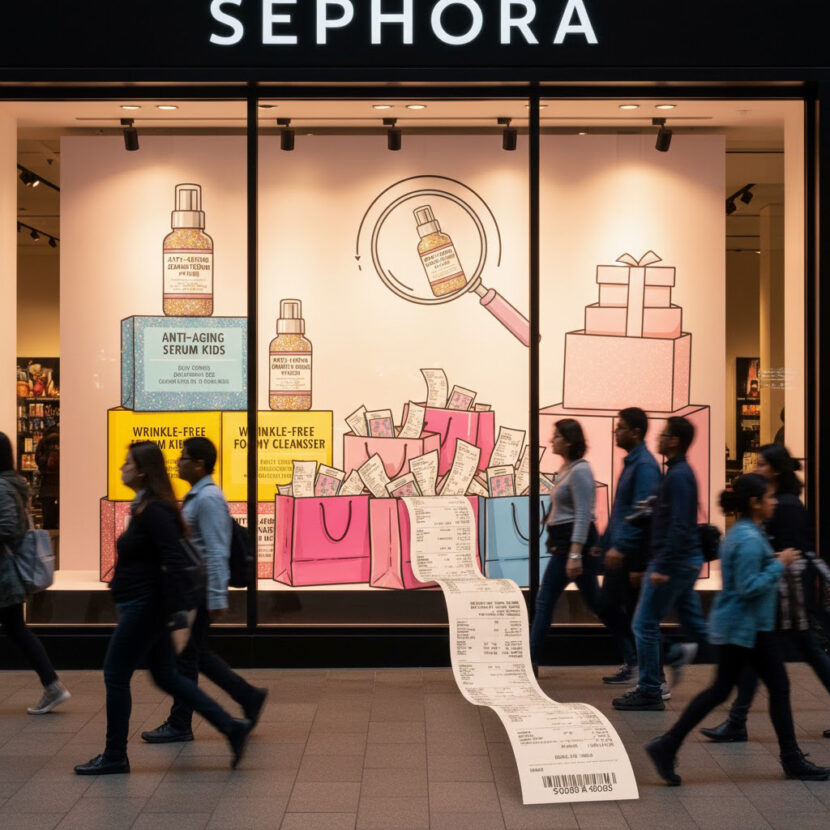
This scene is playing out in Sephora and Ulta stores nationwide, so frequently that these young customers now have a name: “Sephora Kids.” They’re children as young as eight or nine, armed with TikTok-inspired shopping lists, spending hundreds of dollars on anti-aging products designed for adults decades older than them. And according to newly published research and warnings from pediatric dermatologists, the consequences go far beyond overpriced birthday wishlists.
The Numbers Behind the Trend
The “Sephora Kids” phenomenon isn’t just anecdotal; it’s backed by striking data. According to Nielsen, in 2023, American families with kids aged 6–12 bought 27.2% more skincare products than the year before, while families with teens aged 13–17 bought 28.6% more.
A groundbreaking study published in June 2024 in the journal Pediatrics—the first peer-reviewed research of its kind analyzed 100 TikTok videos featuring skincare routines by content creators aged 7 to 18. The findings were alarming: each routine featured an average of six products totaling about $230 CAD, with some girls using more than a dozen products on their faces.
Even more concerning? Only a quarter of the routines included sunscreen use, while the most popular videos contained an average of 11 irritating active ingredients for young skin, such as hydroxy acids, and content creators often layered multiple active ingredients or the same one over and over in multiple products.
What’s Really in Those Colorful Bottles
The products driving this trend aren’t innocent moisturizers. They contain potent active ingredients designed to address aging concerns that don’t exist in pre-adolescent skin: retinol for wrinkles, alpha-hydroxy acids for sun damage, peptides for collagen loss, vitamin C serums for dark spots.
These ingredients are packaged in neon-colored bottles with push-top dispensers that release product in cute shapes that look like toys. Brands like Drunk Elephant, Glow Recipe, and Laneige dominate young shoppers’ carts, with individual products ranging from $38 to $70.
“Children’s skin is thinner and more sensitive than that of adults,” explains Dr. Brooke Jeffy, member of the American Academy of Dermatology. “When kids use anti-aging skincare, it can actually accelerate aging and lead to permanent scarring”.
The Medical Reality: Why These Products Are Dangerous for Young Skin
The concern from dermatologists isn’t theoretical—they’re seeing the damage in their clinics.
Dr. Kathleen Hesterman of Hesterman Dermatology stated she regularly sees mothers bringing in bags of skincare products and their daughters with aggravated skin. “Skin is still maturing – especially if they are prepubescent,” Hesterman said.
Dr. Carla Torres-Zegarra, associate professor of dermatology and pediatric dermatology at the University of Colorado School of Medicine, sees the problem repeatedly: “90% of the time my answer is, ‘You don’t need that because you don’t have the problem this active addresses. This product targets skin changes that develop in adulthood'”.
Retinol: The Biggest Concern
Retinol, a derivative of vitamin A, tops the list of problematic ingredients. While it’s celebrated in adult anti-aging routines for reducing wrinkles and improving texture, it poses specific risks for developing skin.
Dermatologists have expressed concerns about the safety of retinol use in children and teens due to potential side effects such as sun sensitivity, peeling, and dryness, which may pose greater risks for younger skin. The development of the skin’s moisture barrier in youth also makes it more susceptible to irritation and chemical burns from potent active ingredients like those found in retinol serum.
One of the main problems of using retinol cream as a child or teen is that this can disrupt the natural balance of the skin. Typically, children and young teens have skin that is still resilient and is developing and adapting to the environment. Retinol is a powerful ingredient that can disrupt this natural development and cause problems in the future.
The short-term effects include redness, dryness, peeling, and irritation. But there’s also concern about long-term consequences. Dr. Torres-Zegarra notes that while “there’s no danger in using retinol, there’s really no need for a preteen to use it. The benefits of retinol are it helps with the appearance of fine wrinkles, skin discoloration and sunspots, stimulating collagen formation and skin texture, which are essentially not active skin problems of preteens or teens”.
Exfoliating Acids: Too Harsh for Young Skin
Alpha-hydroxy acids (AHAs) and beta-hydroxy acids (BHAs) like salicylic acid are another concern. These acids smooth skin texture and unclog pores but they can lead to dryness, irritation and redness. About one in five exfoliant products and about one in 100 personal care products contains salicylic acid, a common type of these acids.
While these ingredients may support adult skin health, they’re often too harsh for young, sensitive skin that doesn’t yet have the fully developed protective barrier adults have.
Vitamin C and Other Active Ingredients
Even seemingly innocent ingredients can cause problems. Vitamin C, or ascorbic acid, is an antioxidant used to reduce the appearance of dark spots, wrinkles and acne. It can cause itchiness and burning. It is found in about 70 percent of facial moisturizers and about 2 percent of all personal care products.
A comprehensive review published in the Journal of Drugs in Dermatology in August 2024 examined the safety of cosmetic products marketed to children. The review found that current literature and FDA-approved guidelines indicate that ingredients like retinol, exfoliating acids, and vitamin C have not been thoroughly tested in children. Consequently, using these products without medical supervision can pose risks such as skin redness, irritation, heightened sun sensitivity, dermatitis, and other potential adverse effects.
The Psychological Impact: Beyond Skin Deep
The Pediatrics study revealed that the harm extends beyond physical skin damage. “It’s problematic to show girls devoting this much time and attention to their skin,” says Dr. Molly Hales, corresponding author and postdoctoral research fellow and dermatologist in the department of dermatology at Chicago’s Northwestern University Feinberg School of Medicine.
Dr. Hales adds: “What was disturbing to me as a dermatologist, but also as a mom, was seeing how this pursuit of beauty was also tied up in this language of health and self-care. I wouldn’t want these young girls to be getting the message somehow that they need to spend 45 minutes every day and $200 worth of products on skin care in order to be healthy or to be taking care of themselves”.
According to psychologists, getting into elaborate skincare routines at too young an age shifts the focus heavily to appearance, which can increase anxiety, dissatisfaction with one’s body, and even contribute to eating disorders and body dysmorphia.
Dr. David Barnhart, counselor and Director of Behavioral Services, frames it simply: The “Sephora kids” are doing something quite basic to human nature – working to fit in and feel included with their peers. Barnhart said the anxiety around looks is starting younger because of this latest trend, and kids should not have to worry about it at such a young age.
How Did We Get Here? The Social Media Effect
The answer is TikTok, Instagram, and YouTube. These platforms have created an ecosystem where beauty influencers with millions of followers demonstrate elaborate 10-step routines, young “kidfluencers” show off their Sephora hauls, and the algorithm serves this content directly to impressionable pre-teens.
UCLA Health’s Dr. Carol Cheng, assistant clinical professor of dermatology and board-certified dermatologist and pediatric dermatologist, notes: “Information is widely accessible, and so is misinformation. It’s overwhelming and confusing for teens and tweens who may not realize that even peer influencers may just be selling a product in their ‘instructional’ videos”.
A 2021 study found that 75% of teenage acne patients consulted social media for advice. An analysis of popular skincare videos on TikTok, Instagram Reels, and YouTube Shorts revealed that 67.2% were made by users with no dermatologic medical background.
The marketing is sophisticated. Products come in aesthetically pleasing packaging perfect for display on bedroom vanities—they’ve become status symbols. Dr. Hales observes: “Sometimes in the videos, part of it is displaying all of these products that you’ve purchased and have ownership of, like an expensive sneaker collection”.
And it’s working. Teen spending on cosmetic and cosmeceutical products increased by 8% in the past year. The global skincare industry was valued at $146.7 billion in 2021 and is projected to reach $273.3 billion by 2031.
Failed Legislation and Industry Response
Recognizing the danger, California Assemblymember Alex Lee introduced Assembly Bill 728 in early 2024, which would have required age verification at checkout for anti-aging products containing ingredients like retinol and harsh acids. Children would have needed to be with someone over 18 to purchase these products in-store, with similar restrictions online.
The bill quietly died in May 2024 without a vote.
The Personal Care Products Council, the lobby for the skincare industry, opposed the legislation and spent thousands of dollars on targeted ads claiming the bill would require ID “to buy cosmetics”—a misleading characterization that focused on all cosmetics rather than specific anti-aging ingredients.
In response to criticism, the industry points to educational campaigns. The Personal Care Products Council cites examples like Dove’s “The Face of 10” campaign, which encourages kids to embrace age-appropriate beauty standards.
But Dr. Drew Cingel, a U.C. Davis professor who studies the intersection of adolescents, psychology, and social media marketing, notes that telling kids to act their age is more likely to have the opposite effect. When CBS News showed the ads to fifth-graders, several agreed it would probably make them want to buy the products even more.
Quebec took a different approach. In December 2023, Quebec’s Order of Chemists published a warning that some skin-care products designed for adults and popularized on social media should be avoided by children because the active ingredients can be harmful to young skin.
What Children Actually Need: Expert Recommendations
The good news? Healthy young skin needs very little intervention.
Dr. Hesterman suggested that if your child wants to start a “skincare routine,” the best and safest way to begin is with a gentle cleanser and washing their face twice a day. Daily sunscreen use is also important at any age. Most experts and dermatologists agree that your early to mid-twenties are a reasonable time to use anti-aging products. At this point in your life, your skin has developed the protective oils and barriers needed to protect your skin.
Dr. Julia Carroll, a dermatologist and lecturer at the University of Toronto, emphasizes: “The trend creates a dependency where kids think they need a 10-step routine when really they just need a gentle cleanser, a moisturizer and a sunscreen”.
For children and pre-teens, dermatologists recommend:
1. Gentle cleanser – Products like Cetaphil or CeraVe, used morning and night and after sports or sweating.
2. Moisturizer – A simple, fragrance-free moisturizer. Even oily skin needs moisture—depriving oily skin of hydration actually triggers more oil production.
3. Sunscreen – Broad-spectrum SPF 30 or higher, applied every morning and reapplied every two hours during outdoor activities. Dr. Torres-Zegarra notes: “Using sunscreen to avoid cumulative sun damage is the single best anti-aging treatment. We do know that during the first 20 years of life, kids and adolescents get the most exposure to the sun than at any other time in their lifetime. So, they should be very diligent about protecting themselves from the sun. That’s going to have a more positive effect on their skin than going to a beauty supply store to get antioxidants, retinol, vitamin C and any other actives in skin care”.
For teens dealing with acne, dermatologists recommend over-the-counter adapalene gel (Differin), which is much more effective than retinol in treating acne and is specifically formulated for young skin.
If skin concerns persist, the answer isn’t a $230 haul at Sephora—it’s a visit to a board-certified dermatologist who can assess the specific issue and prescribe appropriate, medically supervised treatment if necessary.
Safe Alternatives: When Trends Aren’t All Bad
Not all skincare trends targeting young people are harmful. Dr. Yadav, a dermatologist, points out that “one such trend is the dolphin/cloud/jelly skin trend. Hyaluronic acid is an ingredient in the body that attracts and holds water. A serum that uses water, humectants, glycerin and aloe is a safe way to follow a skincare trend and get glowing skin without the risk”.
The desire to take care of one’s skin isn’t inherently problematic. Dr. Cheng notes: “Preteens and teenagers are more aware of and motivated to take care of their skin compared to what I’ve seen in the past, which is a plus. It’s not necessarily a bad thing to start a routine early when it’s the correct regimen for their skin”.
The key is channeling that interest in age-appropriate, safe directions—with parent guidance and, when needed, professional medical advice.
What Parents Can Do Right Now
1. Have an honest conversation
Talk to your children about why they’re interested in skincare. Is it because they have a genuine skin concern? Are their friends doing it? Did they see it on TikTok? Understanding the motivation helps you address the real issue.
Dr. Galamgam emphasizes: “Kids need to be educated”. Explain that the skin they see online is often heavily filtered and that the “glass skin” or “porcelain” complexions they’re chasing don’t exist in real life.
2. Set boundaries at the store
Despite clear concerns, when CBS News sent undercover tween shoppers to buy adult anti-aging products, no one at Sephora or competitor Ulta Beauty seemed concerned when the undercover tweens bought only products intended for older skin.
Stores won’t stop the sales, so parents need to be the gatekeepers. If your child wants to explore skincare, go with them and help them choose age-appropriate products.
3. Consult a professional before buying actives
Dr. Yadav advises: “If they want to enter the skincare space, parents should bring their children to a dermatologist. We’re best suited to help them understand their skin, such as what is and isn’t safe for them to use, whether that’s a specific product or ingredient”.
4. Monitor social media consumption
While completely restricting access may backfire, be aware of what your child is watching. Look for opportunities to discuss the difference between entertainment content and medical advice, and help them identify when influencers are being paid to promote products.
5. Model healthy attitudes about aging
Sociologist Laura Hurd from the University of British Columbia explains: “We’re selling the idea that we are all against aging, because we should be afraid of it—and better yet, battle it”.
Consider what messages you’re sending about aging, beauty, and self-worth. The fear of aging that drives adults to anti-aging products is now trickling down to children who don’t yet have a single wrinkle to worry about.
The Bigger Picture: What This Trend Reveals
The “Sephora Kids” phenomenon is about more than skincare—it’s a reflection of how social media has fundamentally changed childhood. Today’s kids and teens are increasingly influenced by online culture and their peers rather than traditional authorities like family or school.
As noted in the Mintel report, members of Gen Alpha, who were born roughly between 2010 and 2024, see beauty influencers and their routines as sources of inspiration. “However, this acceleration into adult-oriented skin care often results in routines that prioritize appearance over health — a gap that the beauty industry must address”.
Summer camps have begun specifically asking parents not to send their daughters with elaborate skincare products. Retail employees are documenting their frustration with the trend. Dermatologists are sounding alarms. And yet, the products keep flying off the shelves.
Moving Forward
While legislative solutions have stalled, change is still possible through informed parenting, continued pressure on the beauty industry for transparent marketing, and perhaps most importantly, media literacy education that helps children distinguish between entertainment, advertising, and actual medical advice.
Dr. Christopher Mancuso with Nashua Dermatology Associates puts it simply: “A child’s skin is about as healthy as it gets”.
The best skincare routine for a 10-year-old isn’t found in a $230 shopping cart at Sephora. It’s gentle cleansing, basic moisturizer, daily sunscreen, plenty of water, and the confidence to know that their young, healthy skin doesn’t need fixing.
Because here’s what no influencer will tell them: wrinkle-free skin isn’t an achievement when you’re 10 years old. It’s just being 10.
References
- Stechyson, N. (2025). “‘Sephora kids’ are using anti-aging creams. A new study says harms aren’t just skin deep.” CBC News. Retrieved from https://www.cbc.ca/news/health/sephora-kids-anti-aging-cream-study-1.7563225
- FindMyKids. “Sephora Kids: Why Children Are Obsessed with Makeup—And What Parents Can Do About It.” Retrieved from https://findmykids.org/blog/en/sephora-kids
- Environmental Working Group. (2024). “Protecting ‘Sephora kids’: How to keep tweens safe from harmful skin care and cosmetics.” Retrieved from https://www.ewg.org/news-insights/news/2024/07/protecting-sephora-kids-how-keep-tweens-safe-harmful-skin-care-and
- Watts, J. (2025). “‘Sephora Kids’ Investigation: California bill targeting anti-aging skincare sales to minors dies without vote.” CBS News. Retrieved from https://www.cbsnews.com/news/california-sephora-kids-bill-skincare-concerns/
- Editor’s Beauty. (2025). “Sephora Kids: The Rise of Tween Skincare and the Best Safe Brands to Know.” Retrieved from https://www.editorsbeauty.com/home-2/sephora-kids-navigating-the-tween-skincare-trend-with-safe-and-gentle-brands
- Illing, S. (2025). “How our fear of aging has led to ‘Sephora Kids’.” National Geographic. Retrieved from https://www.nationalgeographic.com/science/article/sephora-kids-mental-health-aging
- Barth, J. (2024). “Are some ‘Sephora kids’ ruining their skin?” Marketplace. Retrieved from https://www.marketplace.org/story/2024/07/09/sephora-kids-tweens-skin-care-makeup-antiaging-serums-tiktok
- Rogers, K. (2024). “The ‘Sephora kid’ trend shows tweens are psyched about skincare.” CNN Business. Retrieved from https://www.cnn.com/2024/03/12/business/sephora-kid-tweens-skincare-obsession/index.html
- WAAY-TV. (2024). “Sephora Kids: Experts weigh in on children using skincare and anti-aging products.” Retrieved from https://www.waaytv.com/news/sephora-kids-experts-weigh-in-on-children-using-skincare-and-anti-aging-products/article_85593522-6b7c-11ef-ba64-f36514beaa05.html
- MacEachern, R. (2025). “TikTok’s ‘Sephora kids’ are embracing expensive skin care.” The Globe and Mail. Retrieved from https://www.theglobeandmail.com/life/health-and-fitness/article-tweens-teens-tiktok-skin-care-sephora-kids/
- Hales, M., Rigali, S., Paller, A., Liszewski, W., & Lagu, T. (2025). “Pediatric Skin Care Regimens on TikTok.” Pediatrics, 156(1), e2024070309. https://doi.org/10.1542/peds.2024-070309
- Journal of Drugs in Dermatology. (2025). “Dermatological Safety of Cosmetic Products Marketed to Children: Insights on the Sephora Kids Phenomenon.” Retrieved from https://jddonline.com/articles/dermatological-safety-of-cosmetic-products-marketed-children-insights-on-sephora-kids-phenomenon-S1545961625P8800X
- FirstDerm. (2024). “Retinol Serum: Is It Safe for Kids and Teens?” Retrieved from https://www.firstderm.com/retinol-serum-is-it-safe-for-kids-and-teens/
- University of Colorado Anschutz Medical Campus. (2024). “Retinol for Kids? What a Preteen Skin Care Routine Should Look Like.” Retrieved from https://news.cuanschutz.edu/news-stories/retinol-for-preteens-what-a-preteen-skin-care-routine-should-look-like
- The Skin and Wellbeing Clinic. (2024). “Ten year olds don’t need retinol, but adults do.” Retrieved from https://www.skinandwellbeingclinic.com/ten-year-olds-dont-need-retinol-but-adults-do/
- Yahoo Style Canada. (2024). “Sephora kids are obsessed with retinol serum. Is it safe for young skin?” Retrieved from https://ca.style.yahoo.com/sephora-kids-retinol-expert-170058005.html
- UCLA Health. (2024). “Kids into skincare may be at risk from influencers promoting inappropriate products.” Retrieved from https://www.uclahealth.org/news/article/kids-skincare-dermatologists-advice
- Elliot Hospital. “Are Trendy Skincare Products Harmful to Children’s Skin?” Retrieved from https://www.elliothospital.org/about-us/newsroom/news/are-trendy-skincare-products-harmful-childrens-skin-1